By Royal Appointment – Uma Patel

After three years of trading, I was eligible to apply for the Royal Warrant for the Windsor store. Because the previous owner was still involved and I’d been the manager for three years, we had all the data we needed, and I’d been in place as the manager for three years. Ownership wasn’t important; the award was given to the person providing the service, so in 1977, I sent in my application.

Unusually, before being recommended to St James’s Palace, and without prior notice, the secretary of the Royal Warrant Holders Association, Colonel Kewon Boyd, sauntered into the shop, complete with an ivory-tipped walking stick tucked under his armpit, and a couple of subordinates in tow. He introduced himself and then asked in his most British Officer’s accent, ‘Mr. Paatel, your certificate in Pharmacy – is it from the University of the Punjaaaab?’

‘No,’ I replied. ‘From the Heriot-Watt University in Edinburgh.’

‘Ah!’ he barked. ‘Edinburgh, yes, excellent!’

That was good enough for him. The application progressed, and in 1977, I was awarded a Royal Warrant by Her Majesty the Queen, and in her Silver Jubilee year to boot! I became the first non-white in the more than 500-year history of the Royal Warrants to receive it from her.

An announcement of the award was published in The London Gazette, – the source of information on the royal diary and notable events.

The BBC picked it up and wanted an interview, but I chose discretion. I didn’t want to parade myself in public. When it comes to any involvement with the royals, it’s always best to keep your mouth shut tight! Of course, word got out to the locals in Windsor, and what was good enough for the Queen was good enough for everyone.

Over the next few years I was invited to join the Rotary Club, the Lions Club, the Masons, and the local Tories even asked me to stand as a councilor for the Castle Ward. So many opportunities opened up for me. I wasn’t into politics or power; I was just happy to serve, to do my job efficiently and to an A1 standard.

Sometime later, Prince Charles began giving out Royal Warrants. I think he gave out about eight or nine of them including, to his shirtmaker, his shoemaker, and feather maker. I applied to get a Royal Warrant from him as well, but  I didn’t get one.

To be honest, I felt a bit miffed, so I rang Sir John Johnston, the Comptroller of the Lord Chamberlain’s Office at St James’s Palace, expressed my disappointment and asked to know why I had not been granted the award. He invited me down to St James’s Palace for a chat. I went in and walked up a magnificent staircase into Sir John’s vast office.

We exchanged greetings, sat down at his lovely big desk and he ordered us some tea. 

“Mr. Patel, what can I do for you?” he asked.

“Well, I applied for the warrant to His Royal Highness for my pharmacy in Windsor, and I’m sure I supplied all the correct details, but I didn’t get it,”

“Ah yes,” he said. “I remember your name came up in the meeting. The Prince just said, “Not this time.” And that was that!”

Although I was disappointed, it made sense. There were very few people who received the warrant from him, and he knew everyone he had granted it to personally.  I never re-applied after that.

I had my warrant from the Queen, I had not yet turned thirty and I felt on top of my game. Business was better than ever and I had found my place in the world.

Lost under a Familiar Sky – Sheela Vara (her father’s story told through his eyes)

Alongside our spot was a large grocery shop, and over the next few days, I went in there to buy our drinks and snacks.

The owner seemed to be watching me from time to time as we worked. I was worried that perhaps it was time to move on. Did he recognise me? Or was he just happy because we were bringing him more business, as our customers bought drinks and food while waiting for their bicycles to be repaired? After a few days, he stopped me as I left the shop. 

“Young man, where are you from?” He asked.

“We’re just here a few days,” I replied. “I…I live in Kibosh.”

I rushed for the door. It was time to leave town.

“Young man!” His voice was firm.

I stopped, but my mind was racing.

“I’m asking where you are from, not where you live!” 

At that moment, I decided that my days of running were over. I turned and looked him straight in the eye and answered in Gujarati. 

“My name is Velji Gadher, and I’m from the village of Ranavave near the city of Porbandar.”

“Aah!” He smiled and nodded. “Now I know where you’re from. I’m Prabhat Singh. I came here ten years ago from Rajasthan.”

We shook hands. I began to relax. It seemed I was not under suspicion.

“You’re doing well out there with your business. You’re making good money?” He asked.

“Enough to live, but it’s never enough. I have to send money to my family back home. They’re in debt.”

“I see.” He nodded. “But why are you running your shop like a hobo here on the side of the road?”

“We travel around the small villages. I have to keep moving to find the work.”

He looked at me thoughtfully for a moment.

“I think, that you are a good, hard-working man, Mr. Velji Gadher, so I have an offer.”

I was tentative. “Ok?”

“Come!”

We walked out of his shop and up to the closed shutter behind where we had set up our repair stall. He unlocked it and lifted it to reveal a small shop. I followed him through a door at the back, where I found myself in a dwelling – with two large bedrooms, a kitchen, and a bathroom.

“This is my property. I have a few empty places like this that I keep. You can live here and set up a proper shop at the front. There are more than enough bicycles here in Kakamega to keep you busy. No need to be a hobo!”

I didn’t know what to say. I just looked around, trying to absorb what I had just been offered.

“Can you pay me some rent?” He asked.

“Yes, of course, but I can’t believe you are offering this to me. You don’t even know me!”

He smiled. “I know a good man when I see one.”

I was overcome with emotion. I was to have my own home and my own shop. Now Pedro and I could sleep safe and warm every night. 

“Thank you, Prabhat. You don’t know how happy this makes me! Lord Rama is smiling on me today. This is the best day of my life!”

“Ok good, so you can pay a small rent and when you make more money, maybe you can pay a bit more. A verbal agreement, ok?”

“Yes! Thank you. Thank you.”

I wanted to tell Pedro the good news, but as I stepped back onto the street, my gut tightened.

Pedro had packed up all the tools and was standing stone-faced. Beside him were three Kenyan police officers.

“Mr. Gadher? Velji Gadher?” The sergeant asked.

“Yes, that’s me, what is this about?”

Prabhat appeared beside me. 

“What’s going on here?” He demanded.

“We’ve been looking for this boy for a while on charges of theft.”

“What? What charges?” I asked in disbelief.

“Mr. Meraman Gadher, your brother. He says you stole tools and equipment from him.”

“Three spanners and a few puncture kits so I could escape his brutality and make money for food! For this, he has had you looking for me for a whole year?” 

“I won’t have it!” Prabhat stepped between the officers and me. “This man is no common thief! I know him, and I know where he comes from. He’s an honest, hard-working man, and I won’t have him arrested for such nonsense. It’s a family matter, not a crime. This is his shop and home now, and this is where he stays!”

The officer stepped forward. “I’m sorry, Mr. Singh. We have to do our job. We’ve been told to apprehend him and bring him back to Kitale. Simple as that.”

“It’s ok, Prabhatbhai,” I said, walking toward the officers. “I need to deal with this once and for all. Pedro, put our stuff in the house. I’ll be back soon.”

I turned to the sergeant. “Take me to my brother!”

Two hours later, I stepped out of the police jeep and stood outside Meraman’s shop. I saw the shock in his eyes when he recognised me. I had grown this last year. Taller and broader.

“So, they found you . . . at last,” He smirked.

I stared him down.

“What do you want from me, brother? I’m no longer your slave now so you want revenge? Is that it?”

He tried to take back control. “You stole from me!”

“What!!? A few old spanners and some patches to make repairs? How much were they worth? Ten shillings?”

“Theft is theft!” he protested. “Vali and me, we trusted you, and you betrayed us!”

“Trusted me? You tied my leg to the wall like a dog at night! You beat me and worked me almost to death! I was like an animal to you, and when I escape this slavery with a few tools so I can make money to eat, you send out the police, wasting their time on such rubbish?”

The sergeant had heard enough.

“Is this true that he only took a few spanners? You told us he stole equipment.”

“It’s not the point!” Meraman was now raging. “He stole my things!”

The sergeant turned to me. “Were you held here against your will, Sir? Were you a captive here? Because that is a criminal offense if you wish to press charges.”

I looked at Meraman and saw the fear in his eyes. He knew what he and Vali were guilty of; their cruelty.

“No,” I said quietly after a few moments. “No charges, it is all written in Lord Rama’s book, that we should leave it for him to punish crimes.” I held Meraman’s gaze. 

“And you.” Said the sergeant turning to Meraman. “Do you wish to proceed with charges . . . for the spanners?”

“He stared back at me, angry now, knowing I was no longer under his thumb. I reached into my back pocket, pulled out a wad of cash, and counted out some notes. 

“Here!” I stepped up to him. “Fifty shillings . . . to cover your costs and the inconvenience.”

Meraman looked down at the money and then back at me. He knew that taking it was the end of the matter and also the end of his power over me.

“Take it!” I snapped.

He grabbed the money with an entitled jerk and turned to walk away.

“Meraman!”

“What?” He grunted, without looking back at me.

“Now you stay out of my life! Never look for me again. You understand?”

He snorted and disappeared into his shop. 

The sergeant looked at me and shrugged. “Well, I think that’s settled. I’m sorry, we can only take you to a bus stop.”

“Thank you, Sergeant. I need to get back to Kakamega. I have a shop to run.” 

“And a home,” I thought to myself. “A place of my own.

From Seriousness To Sincerity! Join the Laughing Rebellion!

Marc Itzler’s insight: “Laughter is intelligence, the ultimate expression of rebellion! A rebellion against guilt, against shame and self-doubt. A rebellion against fear itself.”

Do we have to be angry to have strong feelings?

Do we have to be upset to show that we care about the madness of the world?

And do we have to inhibit our humour and joy to show that something is really important to us?

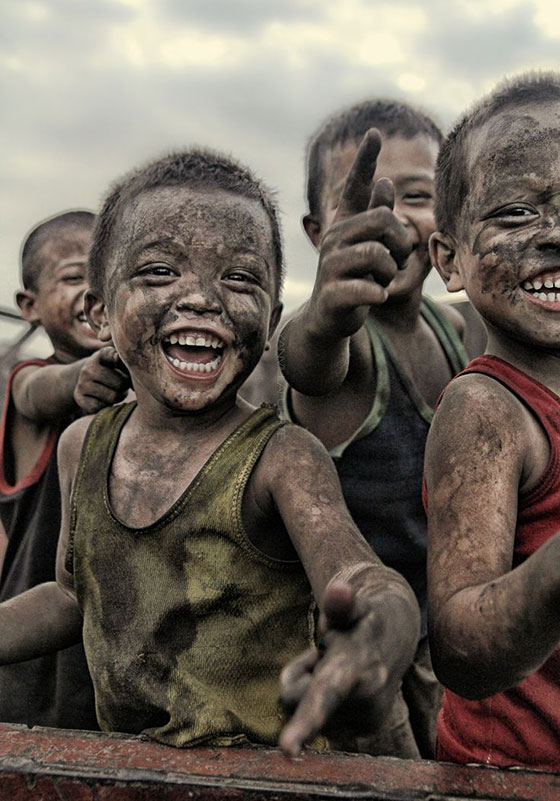
kids laughing

This tension, this apparent contradiction in our lives, when we feel the pain of those suffering, both around us and in distant lands, and yet we know, that to dive into that space, makes us feel dark and contracted, heavy and negative. We feel guilt and shame and frustration. So we look away, we scroll down or we switch off and get on with our lives. But inside, we still care, we still ache.

It is only human to feel empathy, to go into an experience of another’s pain, in order to know it and be there for them. It is a loving act but, it also feels like it spreads the pain out. It expands the very suffering that we anguish over.

This vicious cycle can be so overwhelming, that many of us choose to avoid or ignore the reality of life as it is for us as a global village, as a species, sharing our beautiful little blue ball hanging in infinite space. It’s just too much to let it all in. The corruption, the cruelty and torture, the suffering and the despair of our fellow humans and creatures of this paradise.

We struggle to even work out how we got to this point, let alone where we go from here.

What we do know is that we are in a serious situation.

But are we served by making that state of affairs our state of being? Is our seriousness actually empowering us? Or does it send us into a state of collapse, of defeat, of resignation?

How can we not cry tears of sorrow? How can we not hang our heads in despair?

When we face our greatest fears, the loss of our life or the lives of our loved ones, the loss of our liberty or maybe even worse, the loss of our very hope, then what are our choices? Where is our power?

What happens if in that moment, we decide to let go of seriousness and yet, remain deeply sincere in our truth? What if we can stare fear in the face… and begin to laugh, really laugh, to know that at our deepest core we see the truth and choose to remain free?

Laughter is so often seen as a lack of capacity to understand the gravity of a situation.

It’s frivolous, it’s selfish, it’s a sign that you’re not getting it!

But when we really try to understand laughter, when we get real about what laughter and a sense of humour actually is, then we begin to see that it is, in its purest form, the greatest expression of understanding that we have. Laughter is our body’s reaction to a moment of ultimate clarity, it is how we express the recognition of truth itself. It is what makes satire both deeply funny and deeply moving all at once.

This is because laughter is Intelligence! It is the ultimate expression of rebellion!

A rebellion against guilt, against shame and self-doubt. A rebellion against fear itself.

A rebellious person is a dangerous person. Dangerous to the system, to the status quo. They will not be easily controlled and they will not be easily silenced.

Unhindered by the fear of condemnation and judgement, the rebel is not playing by the book. Not keeping to the script. A rebel will laugh in the face of their own fear, even their own demise. But an intelligent and awakened rebellious and joyful person is always, always sincere! They are led and guided by a bigger picture, a bigger perspective, and that creates an immense freedom. The laughing rebel lives a liberated life. They live an authentic life and a life of courage and truth. Laughter relaxes us, it unites us, it connects us and it heals us.

That is why we must move from seriousness to sincerity. From emotional enslavement to personal power, where we can care, more than ever before!

We can desire and fight for justice, equanimity, and dignity for us all and we can stand strong against the headwind of corruption, against the mass insanity and indoctrination that would have us on our knees in a state of futility, worn out by the sheer size of the challenge.

The dark forces of this world want us to take it all very seriously.

When we are serious, we are open to their message of hate and division. Open to the script of tribalism, nationalism, religious separation and isolation. When we are serious, we are open to dis-ease and disinformation. We can be controlled, because seriousness is fear. It is blind faith and blind action. The serious and scared are easy to control. They are easy to manipulate and indoctrinate.

So if we want to be a part of creating a new world, a new way of living, then we have to renounce seriousness and embrace the power of humour and laughter as a force of vision, of perspective and as an expression of our true authentic being.

Laughter is the expression of this powerful state. It is the manifestation of our deepest truth. That is what the sages and great mystics of history have always taught. Laugh in the face of fear, celebrate, dance and sing in gratitude, because that generates power and conviction in ourselves, it engenders individual thought and values and right now, more than sorrow, more than sympathetic sadness, this world needs sincere, laughing, courageous rebels!